


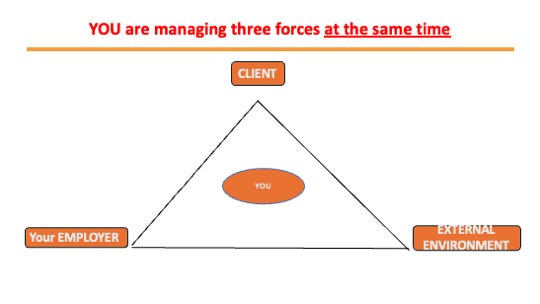
You are not falling apart. Your results are solid. Your clients are mostly satisfied. The people above you respect what you have built over the last twenty years. By every visible measure, you are performing.
And yet, you are exhausted in a way you cannot explain to anyone around you.
That is what burnout looks like in 2026. No breakdown. Not someone who cannot cope. Someone whose way of leading has quietly stopped fitting the world they are leading in. The exhaustion is real. The source of it is specific. And it has three parts.
For twenty years, the leader who knew the most and moved the fastest was the leader who won. Clients came to you because you had the answer. Your company valued you because you could walk into any situation and know what needed to happen. That reputation took a long time to build and it is entirely deserved.
Then AI changed the game. Not gradually. Fundamentally. And most leaders have not been told clearly enough that it has.
The first place the mismatch shows up is with clients.
In the AI era, a client who used to be satisfied with a well-designed solution now feels genuinely uncertain about their own direction. The pace of change around them has accelerated past what their internal teams can process. They are not looking for someone who arrives with a prepared answer anymore. They are looking for someone who can sit with them inside the uncertainty and help them think through it clearly.
That is a thinking partner. And most senior leaders have spent their careers learning to be something different. An expert. A solution provider. The most credible voice in the meeting.
The lesson that corresponds to this is direct. Arrive curious rather than prepared. Ask the client what they are actually trying to figure out before you offer anything from your own experience. Resist the pull to demonstrate what you know before you understand what they need. The conversation that opens up when you do this is the one that builds a real partnership. It is also the conversation your competitors, who arrive with slide decks full of answers, will never get to have.
The second place the mismatch shows up is with the CEO.
Most leaders assume that any concern from above is about performance. It rarely is. The results are solid. The concern is about range. AI has made strategic conversations more complex and more frequent. Clients are no longer asking just about delivery. They are asking about transformation. About what AI means for their people, their operating model, their next three years. The leader who defaults back to their technical domain every time those questions arise is leaving the most important part of the relationship untouched.
The CEO watches this happen repeatedly and worries. Not about whether the leader can deliver. About whether the leader can grow into what the next level of the relationship is asking for.
What is the lesson? To develop range deliberately. Read outside your domain. Spend time understanding how AI is reshaping your clients' industries, not just your own service offering. Walk into client conversations prepared to spend the first part of the meeting inside their world before you mention yours. Range is not a personality trait. It is a practice. And in 2026, it is the practice that separates leaders who deepen relationships from those who maintain them.
The third place the mismatch shows up is the hardest to label, because it lives inside the leader themselves.
AI has made expertise more accessible than at any point in history. Information that used to take decades to accumulate can now be retrieved in seconds. The leader who built their career on knowing more than anyone else in the room is operating in a world where that particular advantage is shrinking every year.
What AI cannot replicate is judgment. Curiosity. The ability to make another person feel genuinely understood. The willingness to say I do not have the full picture here, help me see what you are seeing. These are the qualities that clients in 2026 are paying for, and they require the leader to let go of the identity that has carried them this far.
The lesson here is the most personal one. Real humility is not a soft skill. It is a decision to stop needing to be the most important person in the room, and to find genuine value in what you make possible for the people around you. The leaders who have made this shift describe the experience the same way. The work became lighter not because there was less of it, but because it was finally shared.
Career satisfaction in 2026 is not found by managing the pressure better or by waiting for the environment to slow down. Neither of those things is coming.
It is found by closing the gap between how you are currently leading and what the world is genuinely asking of you right now.
The three lessons above are not complicated.
Arrive curious.
Build range on purpose.
Let go of needing to be the answer in every meeting.
What makes them hard is that each one requires giving up something that has been central to how you have defined yourself as a leader for a long time. That is real work. The leaders who are doing it are the ones finishing their weeks with a sense of genuine contribution rather than mere survival.
That is what career satisfaction actually feels like. And it is closer than most people think.
This Friday on the Bold Conscious Connections podcast, I sit with this question directly. If this is landing for you, listen/watch when it goes live on Spotify.
- Raju
Book a Clarity Call | DM on LinkedIn
Raju Panjwani | Former Morgan Stanley MD | 6X Entrepreneur
Coach to senior leaders at IT services and technology consulting firms