


The banking client you have served for years is deciding, this year, which partners it keeps as it moves its work onto AI. That decision is being made a few floors above the people your leaders talk to every week. They know it. They stay on their floor anyway, and escalate inside your firm instead of walking up inside the client’s. By the time the news reaches you, it has been decided.
I know why they don’t go up. I was afraid of authority for forty years and went up anyway. Both halves are true, and the way they fit together is the useful part.
Sobbing My Way Up
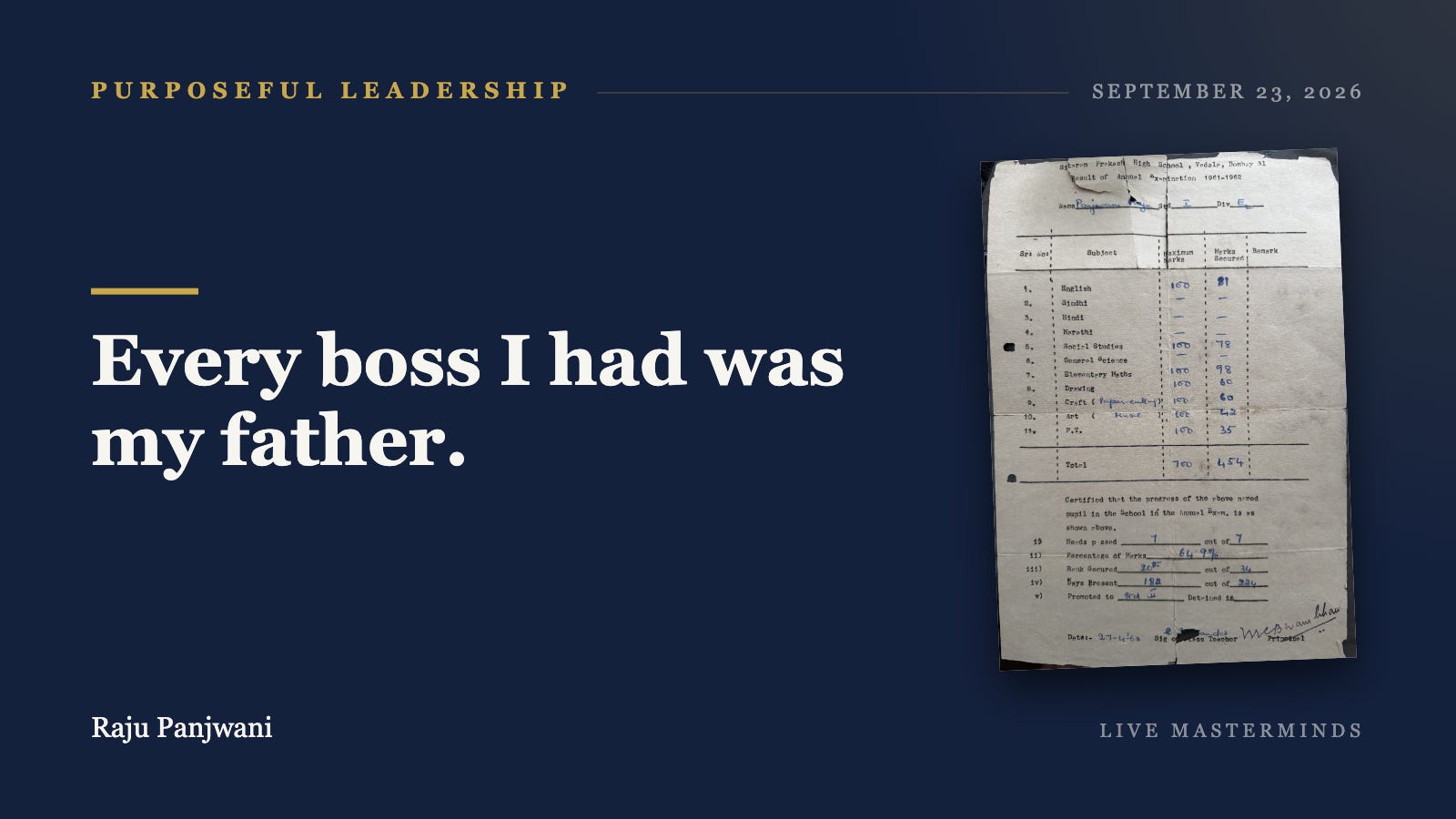
I was a chatty boy in Bombay, six years old, and I never paid attention in class. At the end of first grade the report card ranked me 20th out of 34. I brought it home with no idea it was bad. When my father asked what was wrong with me, I gave him my deadpan answer. “Dad, somebody was 34th too.”
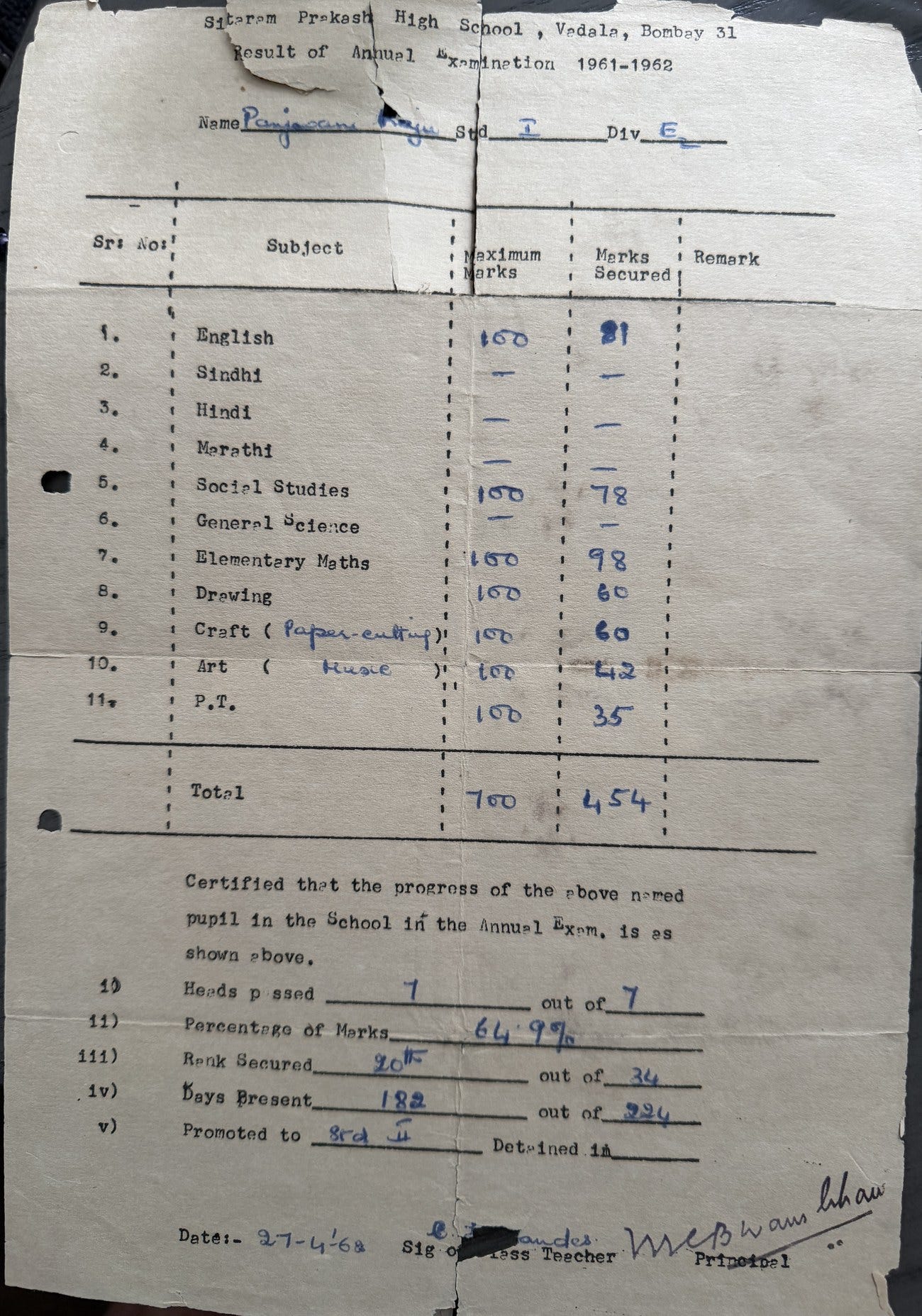
Sitaram Prakash High School, Wadala, Bombay. Annual examination 1961 to 1962. Rank secured: 20th out of 34.
What happened next was a slap. Four fingers across my left cheek. I can still feel where they went.
Later that night, he sat me on his lap in his bedroom and asked, “Wouldn’t it be nice? If Raju is first in science, first in math, first in English, first in geography?” I nodded fearfully through each one, while sniffles from the sobbing earlier had not yet ceased. Of course, I had no idea what I was agreeing to.
I was first in class from second grade all the way through college, all thirteen years of it. The chatty boy had long disappeared. I became reserved and inward, and afraid of anyone who could decide something about my life. He chose my profession. He chose who I would marry.
Getting thrown out
In 1983, Price Waterhouse put me on their engagement at Morgan Guaranty (now JP Morgan Chase), on Wall Street. I had asked HR that Friday not to give me a bank, because I had no banking exposure at all. Monday morning, there I was. Before long, I was in charge of country risk evaluations for the bank. The people I had to sit with included the bank’s chief economist, its loan officers and, on a few occasions, heads of state.
My boss on the job noticed something before I did. Nothing stopped me going into anybody’s office, even if it meant getting thrown out of it. Soft-spoken, almost inaudible at times, and the job still got done.
That looked like a contradiction to me for a long time. I was afraid of authority. I also kept putting myself in front of it, walking into very senior offices to see if I could.
What I worked out at forty-something
It took me until my forties to understand what was going on, and it came from a lot of looking back. Therapy too, in my early 30s. I had made everybody my father. Every boss I ever had was my father. I did my job to make them want me, to make them look good. That is a heavy way to walk into a meeting.
I also learned that the fear does not go away. I had paid out of my own pocket for speaking courses and confidence courses, and taught Dale Carnegie at age 24, hoping it would leave. It didn’t. You have to feel the pain of it and go through anyway.
And then the two halves fit. The boss I treated like my father was one person. The people whose offices I walked into at the bank were not my bosses. I could go to any length with them, because I was doing my job. When you’re doing your job, it has a different flavor. A different stance.
What I would say to you
The leader who stays on his floor knows exactly what is being decided upstairs. He has turned the person upstairs into someone whose approval he has needed since he was six. Nobody trained that out of him, because nobody saw it. It shows up as good manners.
What you can hand him is the sentence that took me forty years. The managing director at the bank is not his boss. He is there to do his job, and his job this year is to know what the banking client is deciding before it decides it. When you’re doing your job, you can walk into any office. You may get thrown out. That costs less than finding out in a quarterly review that the work moved.
This week, ask each of your senior leaders one question. Who at the client, above their day-to-day counterpart, have they sat with in the last quarter? The answer tells you where your revenue is being decided without you.
I was afraid of authority into my forties, and in my twenties I walked into the chief economist’s office at Morgan Guaranty. Both were true at once. Your leader can hold both too.
Get your free personalized read. The Executive Leverage Scorecard, 15 questions, 3 minutes. Results are immediate.
Raju Panjwani | Founder of Live Masterminds, Inc.
I was a Managing Director at Morgan Stanley | I now work with senior leaders in billion dollar IT services and technology firms, on becoming the leader the business now needs.